GIVE ME A HUG :o)

Wednesday, October 13, 2010

Fiction-writing (Part 1)

Posted below is a rough draft of one of my earlier (failed?) attempts at fiction-writing.
For all those who are reading it, please note and keep in mind that this is fiction. Period.


She hates him.

His very presence.

His sight.

The way he stares at her.

Each day. Each minute. Each second.

As if to force him upon her. To remind her every second of his undeniable presence. She wishes to do the same.

But she can’t. And she doesn’t want to figure out why.

She says she has better things to do. She busies herself. She gets lost in her work. She drowns herself in complete nonsense. But she can’t let go off the image.

His image. His eyes. His piercing stare that penetrates right into her body. Her soul. Her corrupt soul.

She tries to hate him. Day in. Day out. She cannot admit that she has failed. She doesn’t even know if she wants to.

But she’s trying. Trying hard. To hate him. To avoid him. To not look at him. To not think about him. To ignore him. Did it not seem easy once?

She is still trying...

And he?


To be continued. . .

Wednesday, October 06, 2010

Of palace and illusions

After having ranted more than what this book probably deserves, here is my review of The Palace Of Illusions by Chitra Banerjee Devakaruni


There were significant reasons for picking up this book, in particular, when I bought it from Crosswords. Firstly, the (ostensible?) subject of the book is the most intriguing epic ever written: The Mahabharata. Secondly, it is a woman's perspective on a male-dominated epic. By male-dominated, I do not mean to say that there are only male characters in an epic that has given women characters far lesser space. In fact, The Mahabharata has some very significant and strong women characters (Draupadi being one of them). And, Devakaruni chooses to re-tell the epic from Draupadi's perspective.

Cleverly, the author has chosen a complex epic like The Mahabharata which can almost always work, no matter what you do with it. Also, to re-tell an epic in someone else's voice is no joke. The story telling is thoroughly exhaustive. So much so that the second half, particularly the details of the Kurukshetra war, narrowly escapes becoming a drag.

Told in a first person narrative, this is her story entirely. What she feels, what she felt and what she always wanted to but couldn’t because of reasons she tries to make sense of over the course of the journey of her life is what this novel is all about.

Renuka Narayanan, in her review of the book published in Hindustan Times, makes a significant point. “Almost nobody names their daughter Draupadi - unless it's for an upaay, an astrologer's trick to stave off the hostile fates by pre-empting their ordained malice with such an 'unlucky' name for the child.”

In terms of the plot, Devakaruni has largely stuck to the original, except for a few significant changes. One case in point is the relationship angle that she tries to explore between Paanchali and Karna. As a young girl, when I used to listen to stories from the epic from my mother and grandmother, I used to visualize this remote possibility too. But I dismissed it sincerely believing that one cannot play with what has already been divinely written. Devakaruni takes full advantage of fiction writing and uses it to weave a plot between two characters who have largely been victims of oppression—one of gender and the other of caste. Interestingly, it’s an untold love story of sorts.

The novel begins on a very fast and compelling note where you want to know what Draupadi secretly desired and wished for, as she was systematically denied all that her brother (Dhrishtidyumna) enjoyed, owing to her gender. Her anger, annoyance and questioning nature paves way for the way her personality develops as she grows into a woman who is identified with vengeance, rebel and pride. The journey of her marriage, her life as a queen, her quest for ‘love’ that always seems so elusive and her dogged insistence on war fuelled by revenge is narrated well by the author. However, I was surprised and somewhat disappointed at the author’s almost casual mention of the Cheerharan episode. For me, it’s a crucial turning point of the epic that changes the course of the entire story. The humiliation that she undergoes in the Sabha had a lot of potential for an author like Devakaruni who is attempting to fictionalize a tale so well-known to the audience. But the way the episode is dealt with leaves you wanting for more. It somehow seemed incomplete.

The story almost becomes a drag when the war-fare is described, possibly because Draupadi now simply plays the role of a distanced story-teller giving us details about the happenings of the war.

All in all, the book left me wanting for more. Its promising start had somehow convinced me that this was a real page-turner, which, frankly, it isn’t. But for all who are interested in and charmed by the great old epic, it’s definitely worth your time and money.

You can read more about this book's review here and here


Tuesday, October 05, 2010

Of pain and loved ones

A statement from a book that I've been shamefully sitting on for the past one month has (as usual) set my contemplative mode in action. As you might have noticed in my earlier rants (if at all you read my posts that regularly and seriously. You are forgiven if you don't), I am still reading The Palace Of Illusions by Chitra Banerjee Devakaruni. I ranted about it in parts in one of my previous posts. You can read more about the book by reading that post. But, for the time being, that is not really necessary.
Here's a statement I picked from the novel:

"To see a loved one in pain is more wrenching than to bear that pain yourself."

In the novel (which is purely fictional) Draupadi, in a reflective and self-interrogative mode, says these lines after having witnessed the great Kurukshetra war. It comes after she realizes that she has lost her brother, sons and father in the great war.
The context isn't really important unless you are too eager to know it.

How true is it? Do you agree? Would you the same? Would you actually believe in it when you say the same?
I asked this question to many of my friends to know what they feel about this.
Most agreed. A few disagreed. A few insisted on knowing details of the context in which the statement was uttered. Even fewer are still confused ( I'm in this category)
Many say that it depends a lot on who the loved one is. Granted. Let's assume the loved one in question is the person whom you care about the most in your life. This could be your mother/father/brother/sister/spouse/close friend, depending upon the individual.

Others say that it's a hypothetical question and cannot be answered unless you are in a similar situation, i.e., if you have, in person, witnessed a similar situation whereby you have been witness to watching your loved one in pain while you yourself are undergoing it. Well....I don't really have an answer to that.

I, personally, insist that a lot also depends on the nature of the pain. Whether it is physical or mental or emotional matters to me as it will significantly impact how I react in such a situation.

Anyways, considering all the above possibilities, problems and loopholes in the statement, what do you, as a random reader of my random rants, feel? Would you agree with the statement? Why? Or why not?

I await your answer in utmost patience and humility...

Saturday, October 02, 2010

Visit to Ramadevara betta and Ranganatittu Wildlife Sanctuary


Question: How are holiday trips planned?

Answer: A day before the departure date :)

Visited Ramnagara, crossed Srirangapatna, Maddur and paid a trip to the Ranganatittu Wildlife Sanctuary, located between the city of Bangalore and Mysore.

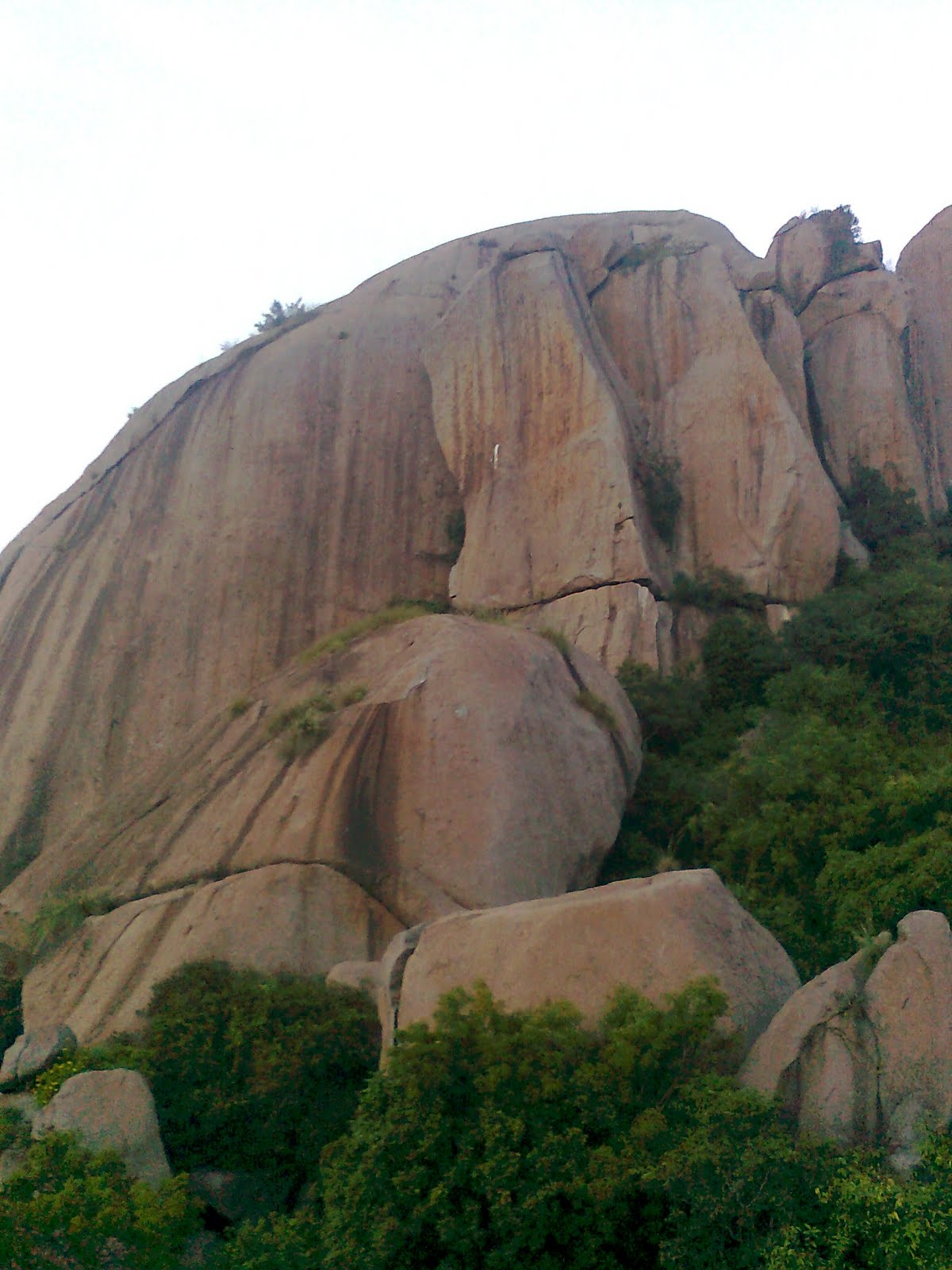
Getting up at 4:30 in the morning is a noteworthy achievement for me and hence I’d like to begin the post by acknowledging the same. The idea behind this crazy act was to catch the sun-rise at Ramadevara betta (a.k.a Lord Rama’s hill). We could have reached earlier possibly but nevertheless it was all worth the trouble.

My friend informs me that apart from several Kannada movies, a few scenes from the epic movie Sholay were also shot at this hill. Another famous award winning International movie ‘A Passage to India’ was also shot here. Catch glimpses of the same here.

Mountain climbing is a sport I had abandoned long long ago…the reason for which is a food for thought. Thanks to this trip, my skills aren’t rusty anymore :))

Climbing those seemingly endless steps…on an empty stomach, mind you (haven’t craved for paal so much before), getting tired in the middle, puffing and panting, ignoring the sweat, when you finally reach the top, it’s almost an indescribable feeling. To be lost in thoughts up above the world so high. To bask in the calmness of the atmosphere. To view the clouds so close. To listen to the sound of silence. It’s a feeling to be experienced in order to understand.

For once, I won’t rant and let the pictures do the talking…

The rocks surrounding the hill that we climbed

The view from 3900feet above the ground

The picturesque sunrise


We had an amazing breakfast at Maddur tiffanys Restaurant. Idli vada, tea and coffee. And of course, the famous Maddur Vada.

Picture courtesy Google Images

Read more about it's recipe here. It’s one of my recent discoveries here! I’m goin to learn how to make it :))


We then proceeded towards Ranganatittu Wildlife Sanctuary. You can read more about it here (and I suggest you do)

Watching crocodiles and crocodile babies so closely, admiring the kingfisher, listening to the noisy swallows and their beautifully constructed nests…a lot of it was a first-time for me. And, I enjoyed it thoroughly.

Again, I’ll let the pix do the talking.

The bird sanctuary situated in the backs of Kaveri river

Spot the crocodile :)

The White Ibis

Spot the baby crocodile ;))

More (and better pix) on FB.

Ta-da!

Wednesday, September 22, 2010

Please watch this

For those of you who still haven't seen/read/heard it, this is a must watch/must see/must listen link.
Please click here and here

Less of 'their' talk and more of 'my' rant on this coming up soon... :))
Meanwhile, I want all your comments to trigger my think tank
Cheers!

Tuesday, September 21, 2010

For your eyes only


Picture credit: Moi

I went to
Netradhama Super Speciality Hospital today in search of story ideas. I got none but I came back satisfied with a lot of information that I had assumed I already knew about. I was wrong. And I am glad I was :-)

As a young child (and even today), eye donation always interested me. I used to wonder with amusement when I thought that my eyes could give light to someone else's life. Let me make it clear that I was no philanthropist (I still don't claim to be one, by the way).
It wasn't altruistic motives but sheer pride that dictated such thoughts. My eyes will give light to someone else. Someone will be able to see the world because of me. It boosted my pride and my ego. So long as it serves the purpose, I don't think the motive matters!


Perhaps eye donations and organ transplantation was also an area of interest because death, as an event, has always intrigued as well as fascinated me at the same time. It's weird to imagine how life for others would be after your death. I have done that a million. I still do and it amuses me even today. Try and imagine how this world would be once you're dead and I gurantee you amusing thoughts. Perhaps you should read Who will cry when you die? by Robin Sharma.
P.S. I tried. But non-fiction bores me to death. Unless, of course, if it's someone like Arundhati Roy
:))

So, anyways... *too much digression*
A chat with Dr. Sagar at Netradhama Hospital was not only informative but also insightful. Donating eyes is the most simplest process. In fact, today I learnt that one eye donation can give vision to 2 persons. So, I decided that, for a change, this post will be an informative and educative one.

Here's some useful information worth noting:
  1. 1.5% of the population are unnecessarily blind
  2. 25% live below the poverty line
  3. 2.5 million children are suffering, including those who don't have the correct spectacles
  4. 32% are under 15
  5. 60% of blind children will not make it to adulthood. A cumulative economic loss to India's GNP of US$11.1 billion
  6. 75% live in rural areas
  7. There are 12,000 ophthalmologists in the country but the majorities of them live and work in the urban areas
  8. 40% live in rural areas in central & northern India where there is little access to quality eye care services

Facts about eye donation

  • Eyes can be donated only after death
  • Eyes must be removed within 4 - 6 hours after death
  • Only a Registered Medical Practitioner can remove eyes from a deceased.
  • The eye bank team will remove the eyes from the home of the deceased or from a hospital
  • Eye removal does not delay the funeral since the entire procedure takes 20-30 minutes only
  • A small quantity of blood will be drawn to rule out communicable diseases
  • Eye retrieval does not cause disfigurement
  • Religions are for eye donation
  • The identities of both the donor and the recipient are kept confidential
Source: Shankara Eye Hospital, Kundalahali Gate, Bangalore-33.

Picture Credit: Google Images

DID YOU KNOW?

Who can donate eyes?
Virtually anyone and everyone

-Age and sex doesn't matter; eyes of deceased can be donated irrespective of age/sex.
-Spectacle wearers, diabetics, hypertensives, asthmatics, tuberculosis, cancer patients can also donate eyes.
-Patients who have undergone eye surgery can also donate eyes.
-Even people who haven't previously pledged, can donate their eyes.

More information regarding the same can be viewed here

Happy reading! :)


Saturday, September 18, 2010

Of blogging and The Mahabharata


It’s a shame I haven’t been able to update my blog for almost 10 days now.

I don’t even have any excuse for the same : o

Guess I’ve been thinking about a lot of issues over the past few weeks and been doing a hell lot of stuff too.

_____________________________________________________________________________________

One of the basic and preliminary problems I face before blogging about anything is to decide what to blog about. The ‘what’ factor dominates my head for a long period of time. It battles with my small-sized brain challenging its limited potential until I (or rather the brain) see Nirvana at the end of the proverbial tunnel. And once I see the light, I cannot rest in peace until everything is put in words. Until my fingers ache of too much typing. Until my brain complains of over-exposure. Until my eyes crib about too much monitor viewing. But it doesn’t stop. I’ve tried my best to stop it, trust me. But it doesn’t. And, I’m probably glad about it.

Now, let’s come to the other secondary (but no less important) problems faced while blogging.

After deciding the ‘what’ factor comes the ‘how’ factor. Now that I’ve FINALLY decided what I’m going to blog about, how do I put it in coherent, simple, understandable words? That’s quite a task, to say the least. To tell something in simple words is a rare art. I may not possess the same (as you might have even noticed at some point in the middle of my rants) but I am working towards developing it. That is precisely why books written in simple language interest me the most. This is not to say that I dislike the canon or the plethora of writers who insist on using flowery language or bombastic words. It’s good, in a way, because it forces me to grab that dictionary and gobble up the meaning of the new word I just read. It increases your vocabulary which is good as it’s most likely to help you in the long run.

But, I would probably prefer Tagore over any one else for the sheer simplicity of his writing. What makes some authors stand out, for me, is the way they express extremely complicated issues and themes in the most simplistic manner. Khaled Hosseini is another author that comes to my mind when I talk about simplicity of expression and language usage. There are probably many more…half of whom I’ve never read and the other half I cannot recall.

Hmmmmm….

So, after having figured the ‘what’ and the ‘how’, is the job over?

Nope. There is still the ‘why’ factor. But, I think, that may be temporarily ignored as long as your what and how are strong. Sometimes you don’t need a reason to blog about something and sometimes you do. Since blogging, by its very nature, is very individualistic, it is also very subjective (like most other things in life which is what makes life so interesting *winks)

Ok.

We’ve had enough of blogging/ (creative) writing lessons for the day. I certainly do not wish to sound like one of those teachers trying to instill the (eluding) skills in the ever-curious pupil.

Since I’ve ranted so much about reading and writing, I think I’ll end this post with what is currently on my reading-list.

My uncle recently gifted The Palace of Illusions (2008) by Chitra Banerjee Devakaruni

I have just begun reading it and I am already getting a feeling that this one’s going to be a good read. Usually, if I get such a feeling so early on, the author has done his/her job of holding the interest of the reader (in this case: me)

"Relevant to today’s war-torn world, The Palace of Illusions takes us back to the time of the Indian epic The Mahabharat—a time that is half-history, half-myth, and wholly magical. Through her narrator Panchaali, the wife of the legendary five Pandavas brothers, Divakaruni gives us a rare feminist interpretation of an epic story.

The novel traces Panchaali’s life, beginning with her magical birth in fire as the daughter of a king before following her spirited balancing act as a woman with five husbands who have been cheated out of their father’s kingdom. Panchaali is swept into their quest to reclaim their birthright, remaining at the brothers’ sides through years of exile and a terrible civil war. Meanwhile, we never lose sight of her stratagems to take over control of her household from her mother-in-law, her complicated friendship with the enigmatic Krishna, or her secret attraction to the mysterious man who is her husband’s most dangerous enemy. Panchaali is a fiery female voice in a world of warriors, gods, and ever-manipulating hands of fate."

Source: Here


They say that the two Indian epics, The Ramayana and The Mahabharata are supposed to be the most intriguing stories ever written and composed. Though mythology is an area that doesn’t interest me per se, having read parts of The Mahabharata in my college years and listened to all those mythological tales from my mother and grandmother in my growing years, the epic still manages to hold its charm. The epic’s real ‘hero’ is still a debatable concept which is great as it encourages you to think, question and ponder over the very concept of who a ‘hero’ or a ‘villain’ is.

_________________________________________________________________________________

Banerjee’s earlier work The Vine of Desire (2002) is a novel I vaguely remember. But I do recall that it was about relationships and marriage—a topic that has interested me for a long while now. And I do remember having recommended it too to a few of my friends

Yes. By now, I think, you might have figured that I love flaunting whatever limited knowledge I possess!!

After all, shouldn't knowledge be shared? * ;-)


Pictures courtesy Google Images

Thursday, September 09, 2010

The day I was the editor…and survived it


They made me the editor today of The Weekly Observer


No. Don’t kill yourself if you haven’t heard of this paper. It’s an in-house publication that is circulated within the four walls of IIJNM in a small village called Kumbalgudu.
Never heard of Kumbalgudu? That’s roughly 20km from Bangalore city.
Never heard of Bangalore? DIE.

So far, about 8 people have asked me the same thing: “How was it? How did it feel do be an editor?”
I only have answer: It’s over. PERIOD.
____________________________________________________________________

LESSONS LEARNT TODAY:

  • Never think that an editor’s job is to simply boss around. It’s not.
  • Never think that an editor has a ‘fixed’ job. It’s never EVER fixed.
  • Never think that once something’s edited, it’s over. It’s never over.
  • Never assume anything. Anything.
  • Always carry Moov. It will come in handy.
  • Sleep well the day before. Or be prepared to have at least 3 cups of tea/coffee(depending on the individual’s preference/situation)
  • Recharge your cell well in advance.
  • Adjust. Be flexible and open to all ideas. Listen. Breathe in and out. Listen some more. Be open. After having done all of these, YELL. Things are usually fine after that.
  • Remember the golden words: “This too shall pass”
  • Learn stress management techniques. Do Yoga. Listen to Rehman instrumental. If nothing works, follow Step 6 (almost always works)
____________________________________________________________________

Simple, isn’t it?
Wait till you be one…