
DAY 2
Martalli village, Kollegal Taluk, Chamrajnagar district, Karnataka state
We had the real feel of what a 'village' is all about.
Yes. We finally visited Martalli, after travelling for over 3 hours by bus on a road that metaphorically (and literally) resembled Om Puri’s cheeks. Add to that the fact that I was sitting in the back seat of the bus. That’s like a bonus for those who want to jump their way to their destination. Quite literally so.
On our way, I befriended a few fellow passengers in the bus, exchanged numbers and greetings. The first question anybody asks me when they hear me speaking (fluently) in Tamil is-where do I hail from? That’s a tricky question for a person like me who is a Tamillian who’s lived in East India, did her graduation from North India and is now in South India doing her PG. I don’t know whether I should say Jamshedpur (my hometwon), Delhi (my maternal grandparents’ place), Tannirpalli (my mom’s birthplace), Tirunnelveli (my dad’s birthplace) or Bengaluru (my current place). It’s quite a mess, to put it simply. And, on top of that, when they hear me speaking equally fluently in Hindi, they find it hard to believe that I’m truly a Tamillian.
But, there are certain things that I learnt today...and all have reference to my (limited) knowledge of Tamil in some way or the other.
I’ve never felt so thankful/relieved/happy/proud about my Tamil roots...until I came here.
I’ve never before been surrounded by so many Tamil speaking people, particularly in the Kannada speaking state of Karnataka.
I’ve never spoken Tamil at such great length, for such a long period, with complete strangers with such confidence.
I never knew that my mother tongue will actually come to my rescue and put me in an advantageous position when compared to the rest of the people in my group who are still struggling with preliminary words like yenne, yenge, yen and teriyadu.
More importantly, I never ever in my wildest dreams thought that my knowledge of reading Tamil would prove to be useful at some point of my life. And, for this, I should truly thank my mom. It was she who insisted and was literally after me and my sister to learn how to read and write Tamil. Our general argument against her insistence would be that it would never be of any use to learn reading and writing Tamil as we would never be reading any Tamil book/magazine/novel, the reason being the high level Tamil used in them. But, for some reason, she was behind us, particularly during the holidays. Also because she taught us at an age when we were too young to protest strongly enough and an age when you grasp and learn things pretty fast, it worked. I still take about a minute to read a single word...but I somehow manage. And, it’s helping me today.
So, thanks amma.
நன்ட்ரி : )
After finalizing a place to stay there (which would be in a room inside a hospital run by a church), we proceeded towards having a long chat with an ex-Panchayat member of the village. We also spoke to the current President of the Gram Panchayat of Martalli and got some useful information. I don’t know how useful it would be....but I guess something is better than nothing.
We had the most awesome lunch today. Rasam, sambhar, aplaam, podalunga curry, oorga and hot steamed rice. We also had omelette. And it all costed Rs. 100/- for 5 people!
Tomorrow, we’ll be shifting from our Kollegal lodge to the village house that we have finalised in the village church on special request from the sisters there. So, the real test actually begins from tomorrow. Apparently, from what we have heard and gathered so far, there are frequent power cuts...and a whole lot of other things that city-people may not be too comfortable with. But, then, that is what this trip is about—to familiarise ourselves with rural way of living.
To come to think about it, rural reporting is fun....as long as you know and understand the local language. Until then, it’s all gotilla!
Looking forward to tomorrow....
Adios!
Monday, October 25, 2010


Sunday, October 24, 2010
Day 1: Kollegal
DAY 1
Kollegal, Karnataka
It wasn’t the best of the starts. And yet, I’m alive and sound to re-tell the same. May be I should be an optimist for a change and feel happy about that, if not anything else.
We started at 6am sharp from IIJNM campus to leave for our much-awaited Taluk visists. We boarded the bus at K. R. Market for Kollegal from there. The journey roughly takes 3 hours (depending on the traffic).By the time we reached Kollegal, it was already noon. I had spoken to Mr. Jacob regarding our place of stay overnight in a deaf and dumb school.
Mr. Jacob has been one of the most useful guys I have come across so far in my trip. Perhaps, that’s not really the truth. (if you read what follows, you’ll probably agree too)
My group has been allotted to cover Martalli and surrounding villages. After talking with Mr. Jacob, we were told that the village is about 60 km from Kollegal. My heart sank when I heard that, as I realized the amount of travelling we would have to do each day.
Let me begin from the beginning.
Once we reached the school, me and another of my group-mate, Gaurav, decided to take Mr. Jacob’s bike and pay Hannur, a village that comes in-between Kollegal and Martalli, a visit to figure out where we will stay. But, as I am God’s favourite child, and He loves me the most, He decided to bless us with a flat tyre.
It’s almost impossible to explain what one feels when one is on a bike with someone you would have least expected to be with (no offense to Gaurav but nevertheless) on a strange road with unknown people around and be forced to stop mid-way with nothing but a flat tyre to stare at. A fellow auto-driver helped us out after making us wait for 15 minutes. He dropped us at the nearest puncture shop. The repairing process took around 45 minutes while Gaurav kept puffing away his blues (silently inspiring me to do the same).
We came back, looked for a lodge in Kollegal and have dumped our luggage there, for the time being. I have no idea how tomorrow is going to turn out when I have the glaring fact of having to travel 120 kms EVERYDAY with a bunch of 4 people who have no idea whatsoever about the local language here, as a consequence of which, they are heavily dependent on me. To be very frank, my knowledge of Tamil is limited too. But, I’m surviving. What scares me more is how are they going to survive, when they are banking entirely on me.
One thing is for sure. This trip teaches/or rather forces you to live and move in a group. We are expected to learn and master team-work. Day 1 hasn’t been that great with this respect. But, I am hoping this will change in the days to come.
In a place where I am struggling to get Internet, electricity, food, and clean drinking water, optimism, strangely, is my only way of survival.
I end my post with thoughts of the kids in the school whose sparkling eyes gave me hope and reminded me of the purpose of my visit.
Will keep you posted. . . . . .
Kollegal, Karnataka
It wasn’t the best of the starts. And yet, I’m alive and sound to re-tell the same. May be I should be an optimist for a change and feel happy about that, if not anything else.
We started at 6am sharp from IIJNM campus to leave for our much-awaited Taluk visists. We boarded the bus at K. R. Market for Kollegal from there. The journey roughly takes 3 hours (depending on the traffic).By the time we reached Kollegal, it was already noon. I had spoken to Mr. Jacob regarding our place of stay overnight in a deaf and dumb school.
Mr. Jacob has been one of the most useful guys I have come across so far in my trip. Perhaps, that’s not really the truth. (if you read what follows, you’ll probably agree too)
My group has been allotted to cover Martalli and surrounding villages. After talking with Mr. Jacob, we were told that the village is about 60 km from Kollegal. My heart sank when I heard that, as I realized the amount of travelling we would have to do each day.
Let me begin from the beginning.
Once we reached the school, me and another of my group-mate, Gaurav, decided to take Mr. Jacob’s bike and pay Hannur, a village that comes in-between Kollegal and Martalli, a visit to figure out where we will stay. But, as I am God’s favourite child, and He loves me the most, He decided to bless us with a flat tyre.
It’s almost impossible to explain what one feels when one is on a bike with someone you would have least expected to be with (no offense to Gaurav but nevertheless) on a strange road with unknown people around and be forced to stop mid-way with nothing but a flat tyre to stare at. A fellow auto-driver helped us out after making us wait for 15 minutes. He dropped us at the nearest puncture shop. The repairing process took around 45 minutes while Gaurav kept puffing away his blues (silently inspiring me to do the same).
We came back, looked for a lodge in Kollegal and have dumped our luggage there, for the time being. I have no idea how tomorrow is going to turn out when I have the glaring fact of having to travel 120 kms EVERYDAY with a bunch of 4 people who have no idea whatsoever about the local language here, as a consequence of which, they are heavily dependent on me. To be very frank, my knowledge of Tamil is limited too. But, I’m surviving. What scares me more is how are they going to survive, when they are banking entirely on me.
One thing is for sure. This trip teaches/or rather forces you to live and move in a group. We are expected to learn and master team-work. Day 1 hasn’t been that great with this respect. But, I am hoping this will change in the days to come.
In a place where I am struggling to get Internet, electricity, food, and clean drinking water, optimism, strangely, is my only way of survival.
I end my post with thoughts of the kids in the school whose sparkling eyes gave me hope and reminded me of the purpose of my visit.
Will keep you posted. . . . . .
Thursday, October 21, 2010
Help
Dear All,
This is to inform you that I'll not be in Bangalore from October 24-31, 2010.
As part of our rural trip, I'll be visiting Martalli village, Kollegal taluk, Chamrajnagar district, Karnataka, along with 4 other students of my class in search of our Masters' thesis project, identifying problem areas in the Maratalli and surrounding villages.
Anyone having any information with respect to the above, please reply to this post or mail me at deepa.r@iijnm.org
P.S. I'm yet to figure out a place to stay!
This is to inform you that I'll not be in Bangalore from October 24-31, 2010.
As part of our rural trip, I'll be visiting Martalli village, Kollegal taluk, Chamrajnagar district, Karnataka, along with 4 other students of my class in search of our Masters' thesis project, identifying problem areas in the Maratalli and surrounding villages.
Anyone having any information with respect to the above, please reply to this post or mail me at deepa.r@iijnm.org
P.S. I'm yet to figure out a place to stay!
Wednesday, October 20, 2010
Zjuvi
Sitting on the bed, enjoying the comfort of my pillow, lazing around...it’s a great feeling to type this.
And I waited far too long for this moment.
Yes.
I finally got my laptop.
*does a jig
Not having a laptop had been the dominant reason for not updating my blog often. Confined to the Media Lab that closes at 11 pm sharp, it maddened me to quite a large extent.
Despite being technologically challenged and possessing (almost) zilch knowledge of computers and software, I badly needed a laptop.
And I’ve finally got one now...after a patient wait for almost 4 years.
It’s called Zjuvi, for now.... named after Zjuvia, Spanish for ‘rain’
I’m hoping to have a long innings with her
: )
Visit to Bangalore Palace
I visited the Bangalore Palace yesterday.
To be very frank, I am not much of a 'historical' person and wouldn't have visited the Palace in the first place had there not been a purpose behind it. My story lies there (and is yet to be completed).
I was supposed to meet a Mr. Michael who was not available at the time of my visit. So, I ended up touring the Palace and clicking a few snap shots from my cell phone slyly (photography charges were extra inside the Palace).
For those interested, the Palace is walkable from Mount Carmel College/Vasanth Nagar Bus Stand. And the entry fee is Rs. 175/- (raised from Rs. 100/- post the introduction of the audio-tour guide). If you're really into history of forts, palaces, rajahs and maharajah's, it's worth it.
 Bangalore Palace, from outside
 A better view...could have taken a better one if I wouldn't have been caught by the security guard
  The inside walls. Apparently it's modelled on Victorian architecture
  A painting showing Cleopatra, the Egyptian queen, giving a piece of her ear-ring as a gift to the Roman emperor, Mark Antony, her lover
 The Maharani's Durbar
  The pool inside the Durbar. Apparently, a gossip area for the ladies of the Palace
 The remote-control given to each tourist for the audio-guided tour of the Palace. Available in 5 languages: English, Hindi, Kannada, Italian, Spanish and German. (Tamil and Telgu to be introduced soon)
 Tourists fidgeting with headphones
Thursday, October 14, 2010
Fiction-writing (Part 2)
Part 2 of the Fiction-writing that began in my previous post
_________________________________________________________________
And he?
He is desperately seeking solace in the web of lies he has so carefully constructed.
He doesn’t know what he’s doing. And, that, ironically, gives him some hope. Some solace (fake though it may be).
He wants to escape. Nay. He needs to escape. He is getting caught in his own web. What can he do? Where can he go?
She is dominating his life. His mind. Heck! His thoughts. He wants to deny that. He wants to escape that. He wants to be alone. Paradoxically, alone with her.
Why? Why her? Why her now? It’s too late. Too late.
The more he thinks, the less he knows. And yet he cannot deny the truth.
The truth. The truth only he was aware of. And now, she knows it too. She wasn’t supposed to...but she does. She knows it all.
He wants to pull her arm, grab her body and kill her with his words.
He knows that his words are his best weapon. His only weapon. He is confident of their enormous power. But he suspects she already knows them. How can she not know? She knew it all along. She was simply pretending ignorance, he insists.
But she can’t beat him. She can never beat him.
If her soul is corrupt, his thoughts are corrupt too. If she can fake ignorance, he can do better.
There are other ways to kill her, he says.
To be concluded...
Wednesday, October 13, 2010
Fiction-writing (Part 1)
Posted below is a rough draft of one of my earlier (failed?) attempts at fiction-writing.
For all those who are reading it, please note and keep in mind that this is fiction. Period.
For all those who are reading it, please note and keep in mind that this is fiction. Period.
She hates him.
His very presence.
His sight.
The way he stares at her.
Each day. Each minute. Each second.
As if to force him upon her. To remind her every second of his undeniable presence. She wishes to do the same.
But she can’t. And she doesn’t want to figure out why.
She says she has better things to do. She busies herself. She gets lost in her work. She drowns herself in complete nonsense. But she can’t let go off the image.
His image. His eyes. His piercing stare that penetrates right into her body. Her soul. Her corrupt soul.
She tries to hate him. Day in. Day out. She cannot admit that she has failed. She doesn’t even know if she wants to.
But she’s trying. Trying hard. To hate him. To avoid him. To not look at him. To not think about him. To ignore him. Did it not seem easy once?
She is still trying...
And he?
Monday, October 11, 2010
Please read
My articles are up on Citizen Matters
Here are the two links:
More Bengaluru women reporting domestic violence cases
Call these helplines to report domestic violence cases
Here are the two links:
More Bengaluru women reporting domestic violence cases
Call these helplines to report domestic violence cases
Wednesday, October 06, 2010
Of palace and illusions
After having ranted more than what this book probably deserves, here is my review of The Palace Of Illusions by Chitra Banerjee Devakaruni

There were significant reasons for picking up this book, in particular, when I bought it from Crosswords. Firstly, the (ostensible?) subject of the book is the most intriguing epic ever written: The Mahabharata. Secondly, it is a woman's perspective on a male-dominated epic. By male-dominated, I do not mean to say that there are only male characters in an epic that has given women characters far lesser space. In fact, The Mahabharata has some very significant and strong women characters (Draupadi being one of them). And, Devakaruni chooses to re-tell the epic from Draupadi's perspective.


There were significant reasons for picking up this book, in particular, when I bought it from Crosswords. Firstly, the (ostensible?) subject of the book is the most intriguing epic ever written: The Mahabharata. Secondly, it is a woman's perspective on a male-dominated epic. By male-dominated, I do not mean to say that there are only male characters in an epic that has given women characters far lesser space. In fact, The Mahabharata has some very significant and strong women characters (Draupadi being one of them). And, Devakaruni chooses to re-tell the epic from Draupadi's perspective.
Cleverly, the author has chosen a complex epic like The Mahabharata which can almost always work, no matter what you do with it. Also, to re-tell an epic in someone else's voice is no joke. The story telling is thoroughly exhaustive. So much so that the second half, particularly the details of the Kurukshetra war, narrowly escapes becoming a drag.
Told in a first person narrative, this is her story entirely. What she feels, what she felt and what she always wanted to but couldn’t because of reasons she tries to make sense of over the course of the journey of her life is what this novel is all about.
Renuka Narayanan, in her review of the book published in Hindustan Times, makes a significant point. “Almost nobody names their daughter Draupadi - unless it's for an upaay, an astrologer's trick to stave off the hostile fates by pre-empting their ordained malice with such an 'unlucky' name for the child.”
In terms of the plot, Devakaruni has largely stuck to the original, except for a few significant changes. One case in point is the relationship angle that she tries to explore between Paanchali and Karna. As a young girl, when I used to listen to stories from the epic from my mother and grandmother, I used to visualize this remote possibility too. But I dismissed it sincerely believing that one cannot play with what has already been divinely written. Devakaruni takes full advantage of fiction writing and uses it to weave a plot between two characters who have largely been victims of oppression—one of gender and the other of caste. Interestingly, it’s an untold love story of sorts.
The story almost becomes a drag when the war-fare is described, possibly because Draupadi now simply plays the role of a distanced story-teller giving us details about the happenings of the war.
All in all, the book left me wanting for more. Its promising start had somehow convinced me that this was a real page-turner, which, frankly, it isn’t. But for all who are interested in and charmed by the great old epic, it’s definitely worth your time and money.
You can read more about this book's review here and here
Tuesday, October 05, 2010
Of pain and loved ones
A statement from a book that I've been shamefully sitting on for the past one month has (as usual) set my contemplative mode in action. As you might have noticed in my earlier rants (if at all you read my posts that regularly and seriously. You are forgiven if you don't), I am still reading The Palace Of Illusions by Chitra Banerjee Devakaruni. I ranted about it in parts in one of my previous posts. You can read more about the book by reading that post. But, for the time being, that is not really necessary.
Here's a statement I picked from the novel:
"To see a loved one in pain is more wrenching than to bear that pain yourself."
In the novel (which is purely fictional) Draupadi, in a reflective and self-interrogative mode, says these lines after having witnessed the great Kurukshetra war. It comes after she realizes that she has lost her brother, sons and father in the great war.
The context isn't really important unless you are too eager to know it.
How true is it? Do you agree? Would you the same? Would you actually believe in it when you say the same?
I asked this question to many of my friends to know what they feel about this.
Most agreed. A few disagreed. A few insisted on knowing details of the context in which the statement was uttered. Even fewer are still confused ( I'm in this category)
Many say that it depends a lot on who the loved one is. Granted. Let's assume the loved one in question is the person whom you care about the most in your life. This could be your mother/father/brother/sister/spouse/close friend, depending upon the individual.
Others say that it's a hypothetical question and cannot be answered unless you are in a similar situation, i.e., if you have, in person, witnessed a similar situation whereby you have been witness to watching your loved one in pain while you yourself are undergoing it. Well....I don't really have an answer to that.
I, personally, insist that a lot also depends on the nature of the pain. Whether it is physical or mental or emotional matters to me as it will significantly impact how I react in such a situation.
Anyways, considering all the above possibilities, problems and loopholes in the statement, what do you, as a random reader of my random rants, feel? Would you agree with the statement? Why? Or why not?
I await your answer in utmost patience and humility...
Here's a statement I picked from the novel:
"To see a loved one in pain is more wrenching than to bear that pain yourself."
In the novel (which is purely fictional) Draupadi, in a reflective and self-interrogative mode, says these lines after having witnessed the great Kurukshetra war. It comes after she realizes that she has lost her brother, sons and father in the great war.
The context isn't really important unless you are too eager to know it.
How true is it? Do you agree? Would you the same? Would you actually believe in it when you say the same?
I asked this question to many of my friends to know what they feel about this.
Most agreed. A few disagreed. A few insisted on knowing details of the context in which the statement was uttered. Even fewer are still confused ( I'm in this category)
Many say that it depends a lot on who the loved one is. Granted. Let's assume the loved one in question is the person whom you care about the most in your life. This could be your mother/father/brother/sister/spouse/close friend, depending upon the individual.
Others say that it's a hypothetical question and cannot be answered unless you are in a similar situation, i.e., if you have, in person, witnessed a similar situation whereby you have been witness to watching your loved one in pain while you yourself are undergoing it. Well....I don't really have an answer to that.
I, personally, insist that a lot also depends on the nature of the pain. Whether it is physical or mental or emotional matters to me as it will significantly impact how I react in such a situation.
Anyways, considering all the above possibilities, problems and loopholes in the statement, what do you, as a random reader of my random rants, feel? Would you agree with the statement? Why? Or why not?
I await your answer in utmost patience and humility...
Saturday, October 02, 2010
Visit to Ramadevara betta and Ranganatittu Wildlife Sanctuary
Question: How are holiday trips planned?
Answer: A day before the departure date :)
Visited Ramnagara, crossed Srirangapatna, Maddur and paid a trip to the Ranganatittu Wildlife Sanctuary, located between the city of Bangalore and Mysore.
Getting up at 4:30 in the morning is a noteworthy achievement for me and hence I’d like to begin the post by acknowledging the same. The idea behind this crazy act was to catch the sun-rise at Ramadevara betta (a.k.a Lord Rama’s hill). We could have reached earlier possibly but nevertheless it was all worth the trouble.
My friend informs me that apart from several Kannada movies, a few scenes from the epic movie Sholay were also shot at this hill. Another famous award winning International movie ‘A Passage to India’ was also shot here. Catch glimpses of the same here.
Mountain climbing is a sport I had abandoned long long ago…the reason for which is a food for thought. Thanks to this trip, my skills aren’t rusty anymore :))
Climbing those seemingly endless steps…on an empty stomach, mind you (haven’t craved for paal so much before), getting tired in the middle, puffing and panting, ignoring the sweat, when you finally reach the top, it’s almost an indescribable feeling. To be lost in thoughts up above the world so high. To bask in the calmness of the atmosphere. To view the clouds so close. To listen to the sound of silence. It’s a feeling to be experienced in order to understand.
For once, I won’t rant and let the pictures do the talking…
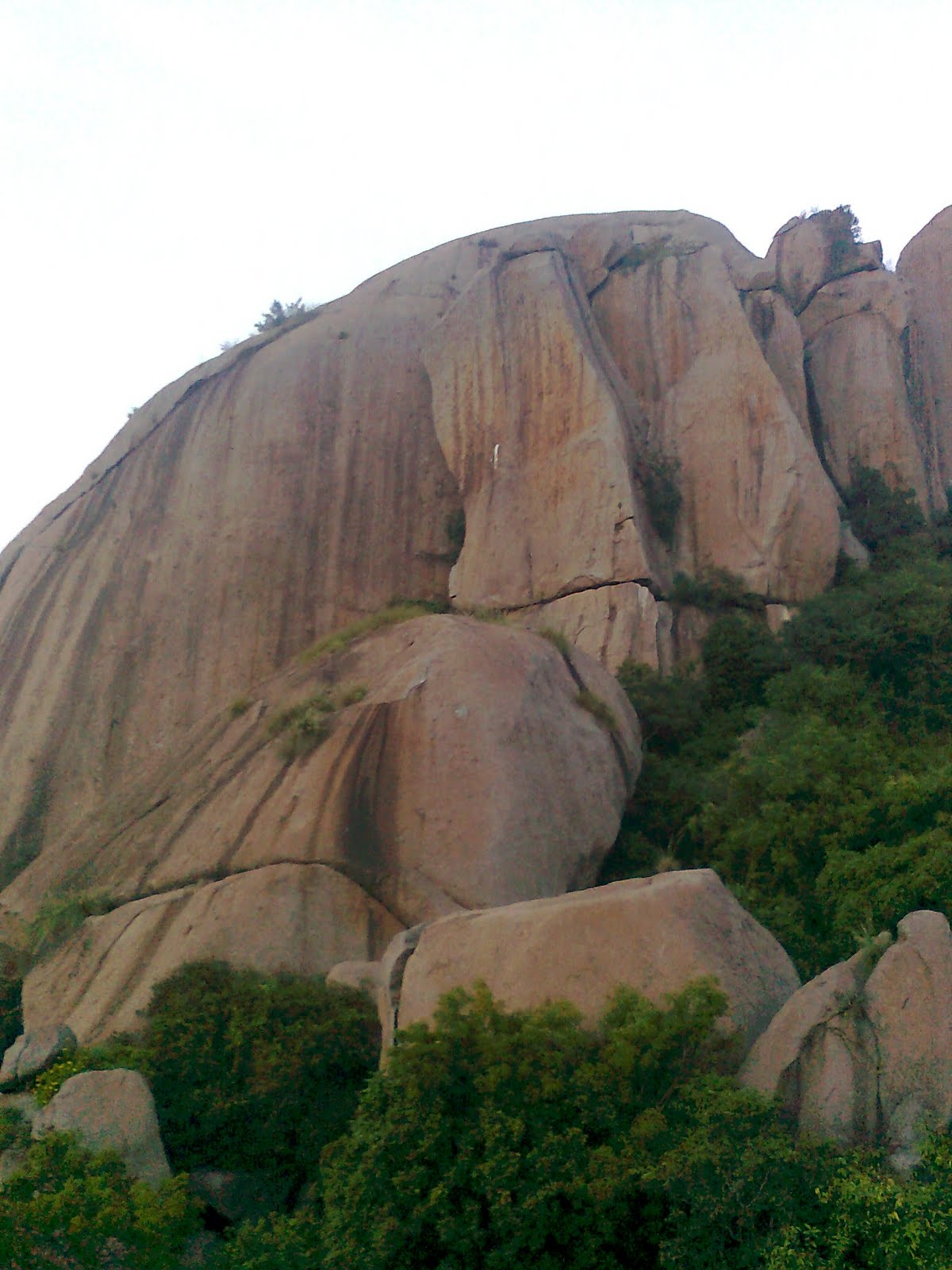
The rocks surrounding the hill that we climbed

The view from 3900feet above the ground

The picturesque sunrise
We had an amazing breakfast at Maddur tiffanys Restaurant. Idli vada, tea and coffee. And of course, the famous Maddur Vada.

Picture courtesy Google Images
Read more about it's recipe here. It’s one of my recent discoveries here! I’m goin to learn how to make it :))
We then proceeded towards Ranganatittu Wildlife Sanctuary. You can read more about it here (and I suggest you do)
Watching crocodiles and crocodile babies so closely, admiring the kingfisher, listening to the noisy swallows and their beautifully constructed nests…a lot of it was a first-time for me. And, I enjoyed it thoroughly.
Again, I’ll let the pix do the talking.

The bird sanctuary situated in the backs of Kaveri river
 Spot the crocodile :)
 The White Ibis
 Spot the baby crocodile ;))
More (and better pix) on FB.
Ta-da!
Wednesday, September 22, 2010
Please watch this
Subscribe to:
Posts (Atom)